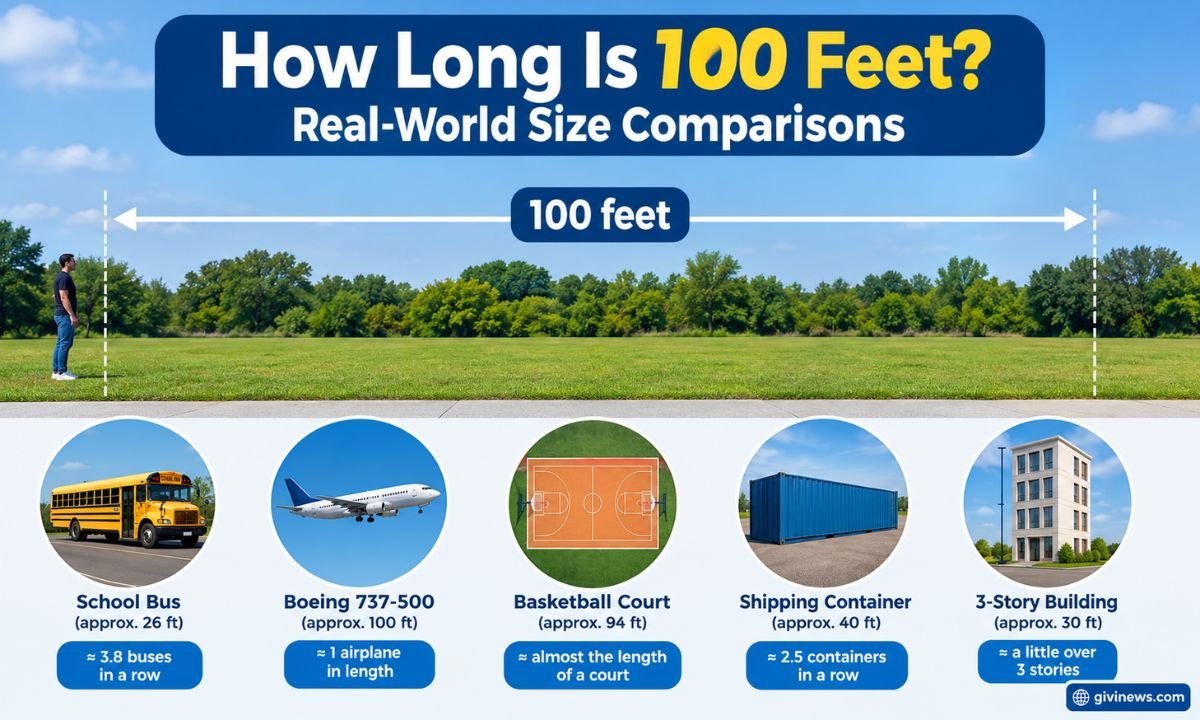
Numbers on a page are hard to picture. You can say “100 feet” a hundred times and still not know whether it fits in your backyard or stretches across a parking lot.
This guide fixes that. You’ll get the exact conversions first, then comparisons you can see in your head, from whales to buses to buildings. You’ll also learn how to measure 100 feet when you don’t have a tape measure.
How Long Is 100 Feet?
100 feet equals 30.48 meters, 1,200 inches, or 33.33 yards.
That is about one-third of a football field and a little longer than an NBA basketball court. A brisk walker covers it in roughly 20 to 25 seconds, or about 40 steps.
One foot is exactly 0.3048 meters under the international standard. That’s where every number below comes from.
Conversion Table
| Unit | 100 Feet Equals |
| Inches | 1,200 in |
| Yards | 33.33 yd |
| Meters | 30.48 m |
| Centimeters | 3,048 cm |
| Kilometers | 0.03048 km |
| Miles | 0.0189 mi |
| Millimeters | 30,480 mm |
What 100 Feet Feels Like
Most people guess 100 feet is longer than it really is. It is closer than you think. You could shout across it and be heard, and you could spot a friend’s face without squinting.
Read More Measurement : How Long Is 100 Feet
Here are four ways to picture it.
How long is 100 feet visually?
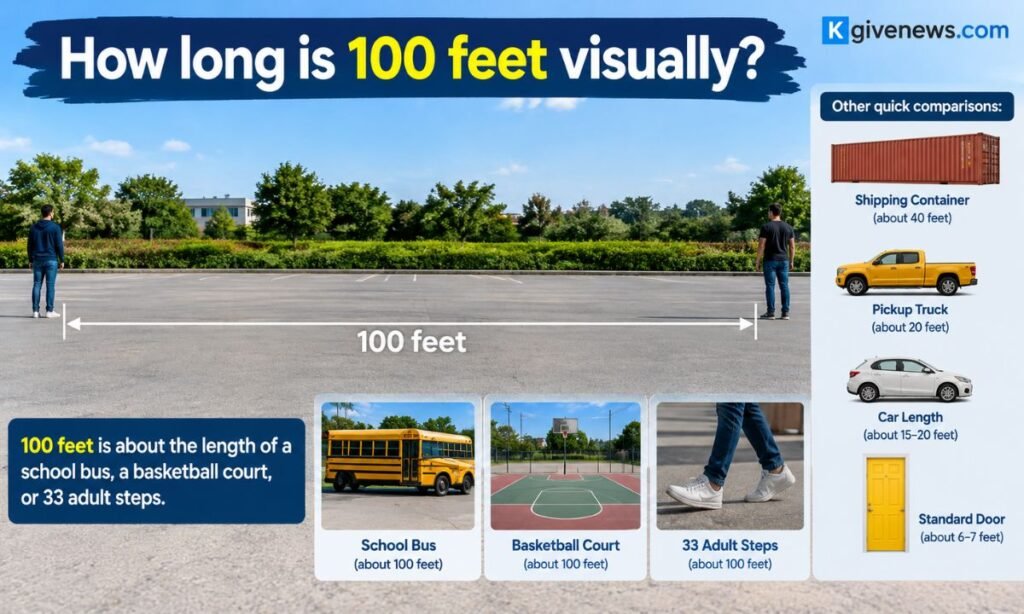
Picture two and a half city buses parked nose to tail. Or think of a tall tree and imagine it lying flat on the ground. A large oak or pine reaches about this height.
How long is 100 feet to walk?
At a normal pace of 3 miles per hour, you cover about 4.4 feet every second. That puts 100 feet at around 23 seconds. Slow walkers might need half a minute. Fast walkers might need 15 seconds.
How long is 100 feet in inches?
It’s 1,200 inches. Multiply feet by 12 and you’re done.
How long is 100 feet width?
Width works the same as length. A strip 100 feet wide holds about eight traffic lanes, since a standard lane is roughly 12 feet. Many residential lots are 50 to 100 feet wide, so a 100-foot-wide lot is a roomy one.
11 Things That Are Exactly 100 Feet Long
A quick note before the list. Real objects rarely match a round number exactly, so most items below are about 100 feet. I’ve listed the actual figure each time so you know how close it is.
1. Blue Whale (Maximum Recorded Length)
The blue whale is the largest animal known to have lived. The longest recorded individuals reach roughly 98 to 100 feet. Most adults are shorter, around 70 to 90 feet.
Stand one against a three-story house and it would stick out past both ends.
How long is 100 feet compared to a football field?
A football field is 100 yards between the goal lines. That’s 300 feet. So 100 feet covers one-third of the playing field. With both end zones included, the full field runs 360 feet.
People mix up yards and feet all the time. If you’re ordering fence, cable, or hose, check the unit twice.
How long is 100 feet in a room?
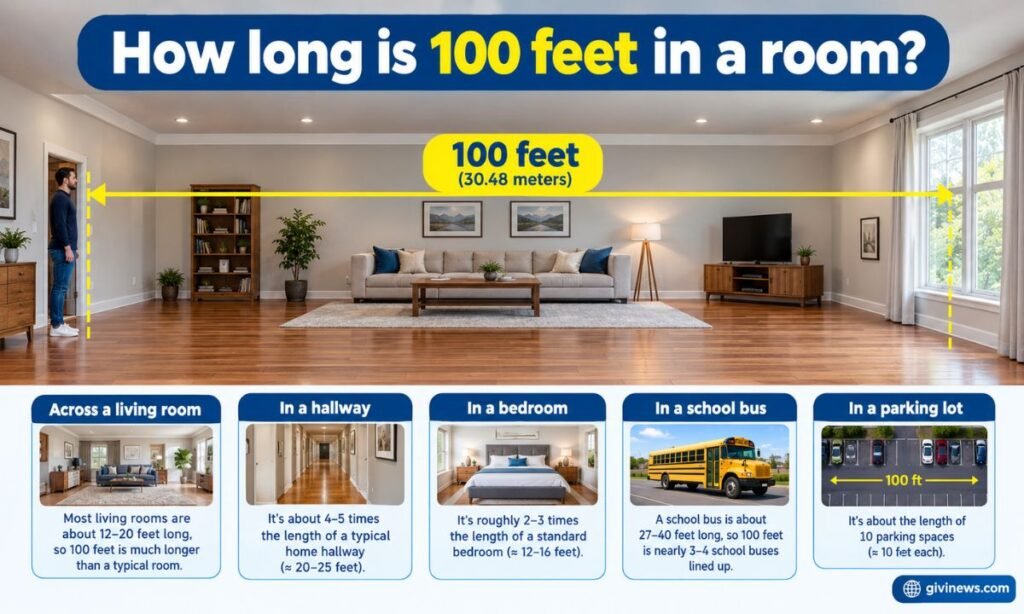
A typical living room runs 15 to 20 feet along its longest wall. Line up five or six of them and you’re near 100 feet. Inside a house, you’d have to walk through most of the floor plan to cover it.
2. 10-Story Building (10 Feet Per Floor Standard)
Most commercial buildings use about 10 feet of height per floor. Ten stories gives you 100 feet. Residential floors are often a little shorter, so a 10-story apartment block can come in just under that.
Look up at a mid-rise office tower and you’re looking at roughly this height.
3. Boeing 737 Wingspan
The Boeing 737 comes in several versions, and the wingspan changes with each. The 737-700 spans about 112 feet with winglets. The popular 737-800 is around 117 feet. The earliest 737-100 was closer to 93 feet.
So the wings of a common short-haul jet are a bit wider than 100 feet. Walk from one wingtip to the other and you’ve covered the distance, plus a few steps.
4. Statue of Liberty Pedestal Height
The pedestal under the Statue of Liberty stands about 89 feet tall. That is a little short of 100, but it gives a clear sense of scale. Add another 11 feet and you have the full distance.
The whole monument, from the base of the foundation to the tip of the torch, rises about 305 feet. That’s roughly three times the length we’re measuring.
How long is 100 feet in miles?
It’s 0.0189 miles. That’s less than 2% of one mile. A mile holds 52.8 stretches of 100 feet.
100 feet to cm
100 feet equals 3,048 centimeters. Multiply by 30.48 for any feet-to-centimeter conversion.
5. Niagara Falls (Horseshoe Falls Height)
Horseshoe Falls drops about 167 feet, according to common measurements. That makes 100 feet a little more than half of the fall. Watch the water plunge and imagine the top 60 percent of it. That’s your 100 feet.
Some of the smaller drops on the American side are closer to 100 feet when measured to the rocks below.
6. Four City Buses Lined Up

A full-size transit bus is about 40 feet long, so 100 feet is only two and a half of them. To reach 100 feet with four vehicles, think smaller. Four 25-foot shuttle buses or minibuses parked bumper to bumper come out right at 100.
Either way, it’s a short line. You’d see it end at a glance.
7. Parking Spaces in a Row (Standard Lot Layout)
A standard parking space is about 9 feet wide and 18 feet long. Lay eleven spaces side by side and you get 99 feet.
This is one of the easiest comparisons to check yourself. Next time you’re in a lot, count eleven painted lines and you’ve found 100 feet.
8. Football Field Section (NFL Regulation Context)
An NFL field is 160 feet wide and 300 feet long from goal line to goal line. Take a section from the goal line to the 33⅓-yard mark and you have exactly 100 feet. In practice that’s just past the 33-yard line, which makes it easy to spot on TV.
9. Basketball Court (NBA Length)
An NBA court is 94 feet long. That’s only 6 feet shy of 100. If you’ve ever sprinted baseline to baseline, you’ve nearly run 100 feet.
10. Baseball Base Path
The bases on a baseball diamond are 90 feet apart. Running from home plate to first base covers 90 feet. The extra 10 feet is about one and a half batters standing in a line.
11. A Large Sauropod Dinosaur
Estimates for giant sauropods such as Argentinosaurus put them at roughly 100 feet or more, from nose to tail tip. Scientists only have partial skeletons, so the numbers carry real uncertainty. Still, it’s a useful picture of how big the largest land animals got.
We hope you loved this one, here we have more guides on feet for you:
- How Big Is 50 Feet?
- How Long Is 200 Feet?
- How Far Is 500 Feet?
- How Tall Is 10 Feet?
How Big Is 100 Feet?

For area, 100 feet is a side length, not a total. A square that measures 100 feet on each side covers 10,000 square feet. That’s about 0.23 acres, which is close to the size of a typical suburban house lot.
A rectangle of 100 by 50 feet covers 5,000 square feet. Knowing the difference between linear feet and square feet saves you from costly buying mistakes with flooring, fencing, and sod.
How Tall Is 100 Feet?
Stand 100 feet straight up and you’re at the height of a 10-story building. That’s about 16 adults stacked head to toe, assuming an average height near 6 feet.
For reference, many cell towers run between 100 and 150 feet. The Statue of Liberty’s torch hand sits well above that mark.
How Far Is 100 Feet?
You can talk to someone at this distance in a normal voice, and you can recognize a face. A thrown baseball covers it easily. A runner finishes it in about 3 to 4 seconds. For drivers, it’s the rough distance a car travels in about one second at 70 miles per hour.
100 Feet Comparison
Use this table when you need a quick reference.
| Object | Length | Compared to 100 ft |
| Blue whale (max) | ~98–100 ft | Nearly equal |
| 10-story building | ~100 ft | Equal |
| Boeing 737-800 wingspan | ~117 ft | About 17% longer |
| NBA court | 94 ft | 6 ft shorter |
| Baseball base path | 90 ft | 10 ft shorter |
| Statue of Liberty pedestal | ~89 ft | 11 ft shorter |
| Transit bus | ~40 ft | 2.5 buses = 100 ft |
| Football field (goal to goal) | 300 ft | 100 ft is one-third |
How to Measure 100 Feet Without a Tape Measure
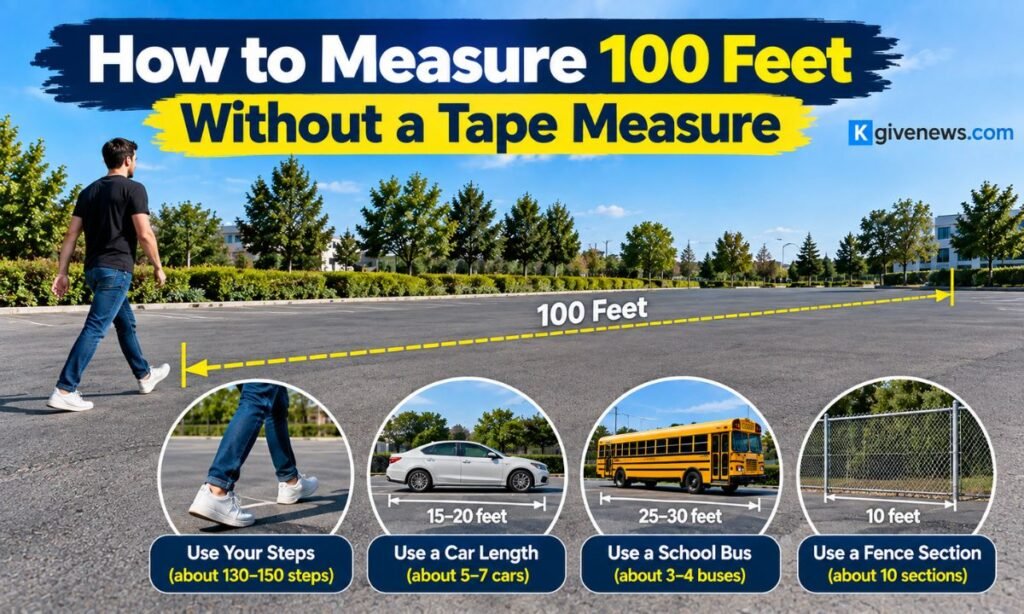
No tape? No problem. Pick any of these three methods.
Method 1 — Steps
An average adult step is about 2.5 feet. That means 40 steps get you close to 100 feet.
For better accuracy, measure your own stride first. Walk 10 steps, measure the distance once with any ruler, and divide by 10. Then multiply your personal stride by the number of steps you need.
Method 2 — Floor Tiles
Many homes and stores use 12-inch tiles. In that case, count 100 tiles end to end. With 18-inch tiles you’d count about 67. Check the size first, since tile sizes vary.
Method 3 — Body Measurement
Your body works as a ruler once you know its numbers.
- Foot length: an adult foot is close to 1 foot. Walk heel to toe for 100 foot-lengths.
- Arm span: for most adults, arm span roughly equals height. At 5.5 feet, you’d need about 18 arm spans.
- Hand span: about 8 to 9 inches, which is handy for short checks.
None of these will beat a laser measure or a surveyor’s wheel, but they’re good enough for rough planning.
Read More Measurement : How Long Is 100 Feet
FAQs
How many yards is 100 feet?
100 feet equals 33.33 yards. Divide feet by 3.
How many meters is 100 feet?
It’s 30.48 meters.
Is 100 feet longer than a football field?
No. A football field is 300 feet from goal line to goal line, so 100 feet is only one-third of it.
How many steps is 100 feet?
About 40 steps for an average adult, based on a stride of roughly 2.5 feet.
How long does it take to walk 100 feet?
Around 20 to 25 seconds at a normal walking pace.
How many stories is 100 feet?
Roughly 10 stories, assuming 10 feet per floor.
How many inches is 100 feet?
It’s 1,200 inches.
Is 100 feet the same as 100 yards?
No. 100 yards is 300 feet, which is three times longer.
Summary
100 feet equals 30.48 meters, 1,200 inches, or 33.33 yards. It’s about the length of a 10-story building’s height, a bit less than a blue whale at its largest, and one-third of a football field. You can walk it in around 40 steps and about 23 seconds.
Use the comparisons that fit your situation. Count eleven parking spaces, line up two and a half buses, or pace out 40 steps. Once you’ve done it once, you’ll have a feel for the distance that numbers alone can’t give.










1 thought on “How Long Is 100 Feet? Real-World Size Comparisons”