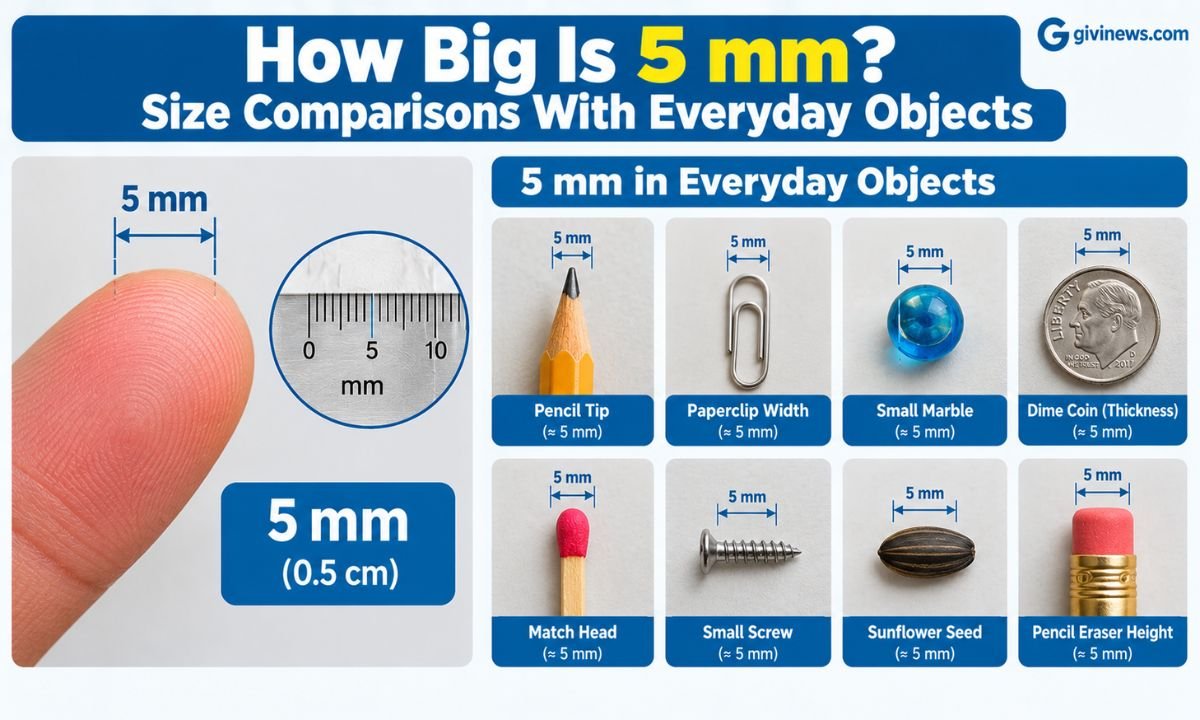
Five millimeters is small enough to lose between couch cushions and big enough to see clearly. It’s about the width of a black peppercorn or a standard pencil eraser’s thickness. The number sounds abstract, though, so this guide turns it into things you can picture, hold and measure.
You’ll get conversions, ten real objects, ruler tips, medical context and a few tricks for estimating 5 mm with no tools at all.
5mm at a Glance
5 mm equals 0.5 cm, or about 0.197 inches. That’s just over 3/16 of an inch. On a metric ruler, it’s five of the smallest tick marks.
| Unit | Value |
| Millimeters | 5 mm |
| Centimeters | 0.5 cm |
| Meters | 0.005 m |
| Inches (decimal) | 0.197 in |
| Inches (fraction) | Just over 3/16 in |
| Micrometers | 5,000 µm |
If you remember one thing, make it this: ten of these laid end to end make 5 cm.
Conversion Table
Here are common small measurements next to 5 mm, so you can see where it sits.
| Millimeters | Centimeters | Inches (approx.) |
| 1 mm | 0.1 cm | 0.039 in |
| 2 mm | 0.2 cm | 0.079 in |
| 3 mm | 0.3 cm | 0.118 in |
| 4 mm | 0.4 cm | 0.157 in |
| 5 mm | 0.5 cm | 0.197 in |
| 6 mm | 0.6 cm | 0.236 in |
| 8 mm | 0.8 cm | 0.315 in |
| 10 mm | 1 cm | 0.394 in |
The formula: divide millimeters by 25.4 to get inches. For 5 mm, that’s 5 ÷ 25.4 = 0.197.
How to See 5mm Right Now Using Your Hand
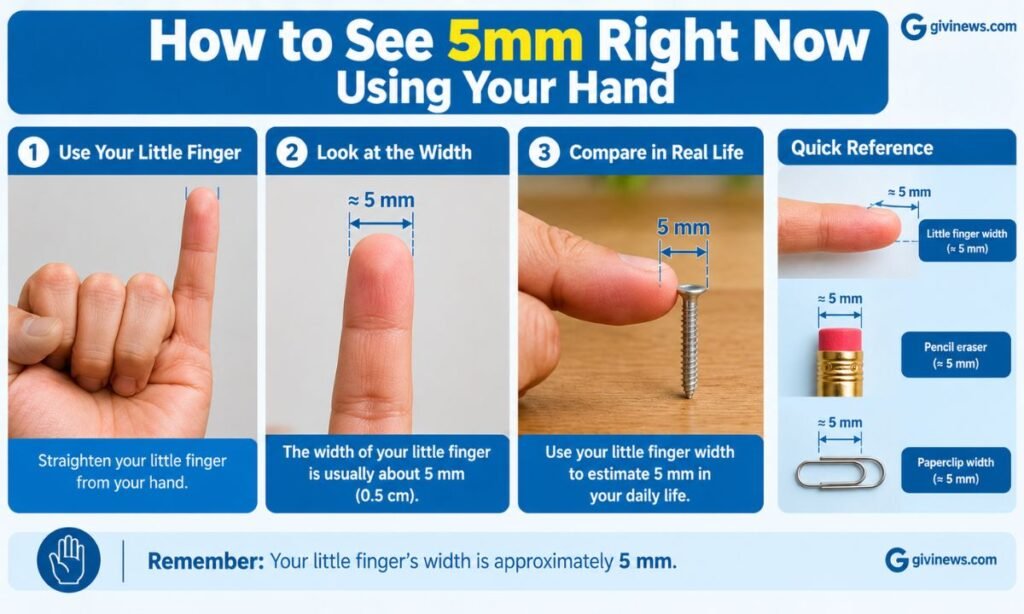
You don’t need a ruler to get a rough picture. Try these:
- Pinky nail: Many adults have a pinky nail roughly 8 to 10 mm wide. About half of that width is close to 5 mm.
- Thumb pad ridges: Pressing your thumb into a soft surface leaves a dent, but it’s far too large to compare. Use a single skin crease instead.
- A grain of coarse salt next to a peppercorn: If you’re in the kitchen, a black peppercorn is a decent stand-in.
Hands vary a lot, so check your estimate against a real ruler once. After that, your eye will be surprisingly accurate.
Read More Measurement : How Big Is 5 mm
10 Real Objects That Are Exactly 5mm
Each item below is commonly made or sold at 5 mm. Manufacturers use slightly different tolerances, so treat “exactly” as “the standard nominal size.”
1. 5mm LED Bulb
The 5 mm LED is one of the most common electronics parts. It’s the small dome-shaped light you see on breadboards and old remote controls. Its lens diameter is 5 mm, which makes it a handy size reference for hobbyists.
2. M5 Bolt
The “M5” label means a metric thread with a 5 mm outer diameter. M5 bolts hold together bike racks, shelving, computer cases and furniture. The head is wider, but the threaded shaft is the 5 mm part.
3. 5mm Drill Bit
A 5 mm drill bit makes a hole 5 mm across. It’s a standard size in most home toolkits and is often used for wall plugs and small pilot holes.
How Big Is 5 mm in cm?
5 mm is 0.5 cm. Divide millimeters by 10 to get centimeters, so half a centimeter.
How Big Is 5 mm on a Ruler?
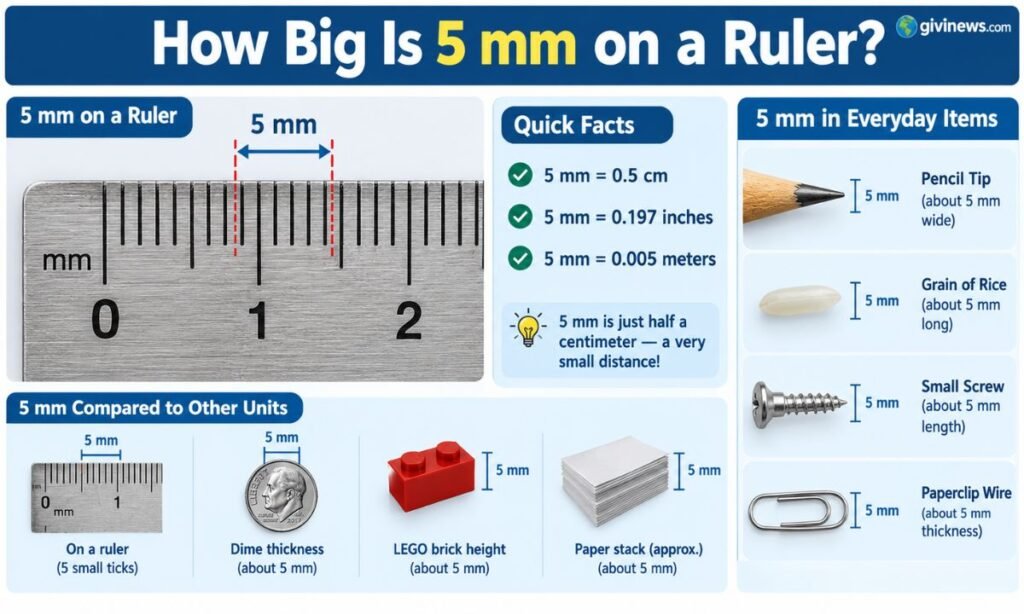
On a metric ruler, find the zero mark and count five of the small lines. The fifth line is 5 mm. It’s often the slightly longer mark halfway between 0 and 1 cm.
How Big Is 5 mm Tumor?
A 5 mm tumor, nodule or lesion is about the size of a pea’s width or a pencil eraser. It’s small in absolute terms. Size alone doesn’t say whether something is harmless or serious, because that depends on the type, location and whether it’s changing. If you’ve been told about a 5 mm finding, ask your doctor what it means for you and whether follow-up imaging is planned.
How Big Is 5 mm in Inches?
5 mm is about 0.197 inches, or just over 3/16 of an inch. In woodworking and hardware, the nearest common fractions are 3/16 in (4.8 mm) and 13/64 in (5.2 mm).
4. 5mm Pearl
Small freshwater and seed pearls are sold in 5 mm sizes. They’re popular for stud earrings, delicate necklaces and beading. At this size, you can see the luster but not much detail.
5. 5mm Round Bead
Craft stores stock 5 mm beads in glass, wood, acrylic and metal. They’re common in bracelets, rosaries and kids’ craft kits. Fifty of them in a row measure 25 cm.
6. 5mm Jump Ring
Jump rings are the little open loops used to connect pieces of jewelry. A 5 mm ring is a typical size for lightweight chains and charms. Always check whether the listing means inner or outer diameter, since the difference is noticeable at this scale.
7. 5mm Ball Bearing
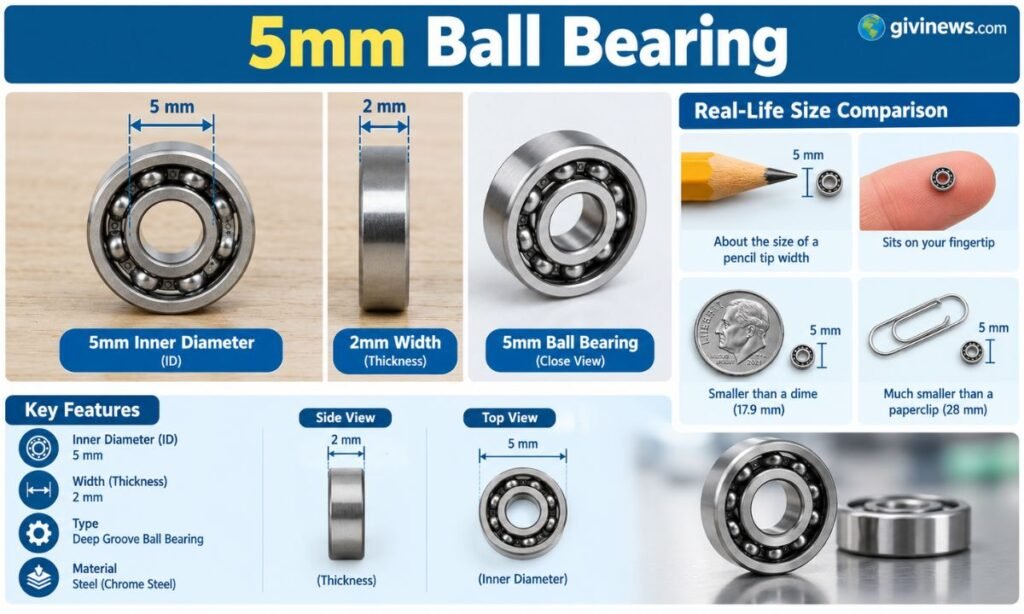
Steel ball bearings in 5 mm are used in bike hubs, skateboards, fidget toys and small machines. They’re also sold loose for repairs and hobby projects. Keep them in a closed container, because they roll away fast.
8. 5mm Hex Key
A 5 mm hex key (Allen key) is one of the standard sizes in a metric set. The 5 mm refers to the distance between two parallel flat sides of the hexagon. It fits many bike components and flat-pack furniture screws.
How Big Is 1 mm on a Ruler?
1 mm is the distance between two neighboring small lines on a metric ruler. It’s about the thickness of a credit card’s edge doubled, or roughly a pinhead. Five of them make 5 mm.
9. 5mm Dowel Pin
Dowel pins are small cylinders used to line up wood or metal parts. A 5 mm pin is common in cabinet-making and furniture assembly. It’s thin enough to slip into a small hole and sturdy enough to hold alignment.
10. 5mm Rivet
Rivets in 5 mm are used in leatherwork, sheet metal and lightweight construction. The 5 mm usually refers to the shaft diameter, not the head. You’ll find them on bags, belts and equipment panels.
Here we have more size guides:
If you like visual size references, these related guides follow the same format:
- How big is 1 mm?
- How big is 2 mm?
- How big is 3 mm?
- How big is 10 mm?
- How big is 1 cm?
- How big is 1 inch?
(Link each title to its page on your site for internal linking.)
5mm Compared to Common Sizes
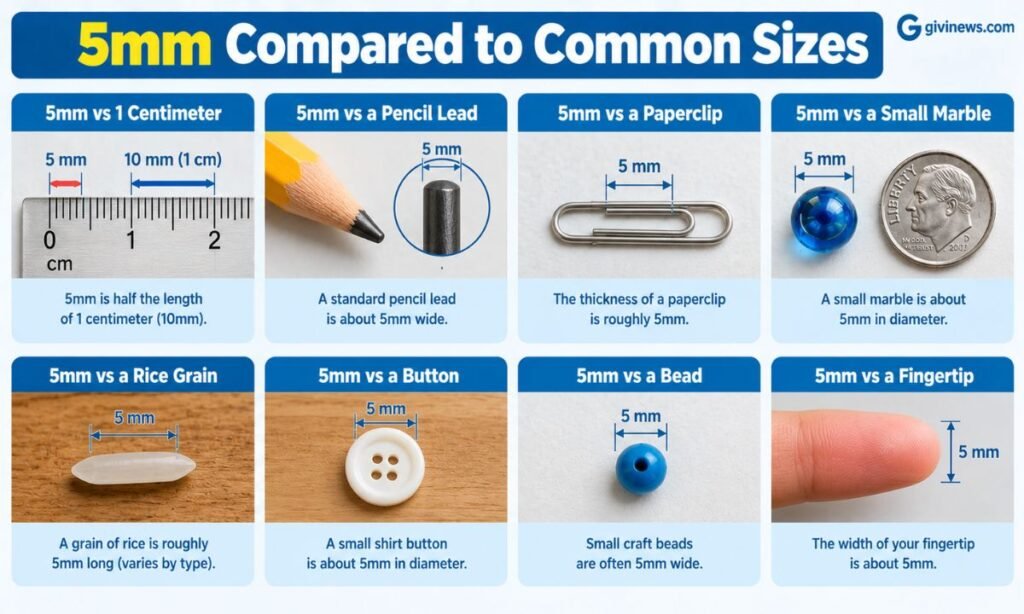
Some everyday items are smaller than 5 mm, some are close, and some are far bigger. This table helps you place it.
| Object | Approx. size | Compared with 5 mm |
| Credit card thickness | 0.76 mm | Much thinner |
| US dime thickness | 1.35 mm | Much thinner |
| US penny thickness | 1.52 mm | About one-third |
| Grain of rice (width) | 2–3 mm | About half |
| Black peppercorn | 4–6 mm | Similar |
| Ladybug (length) | 4–8 mm | Similar |
| Standard pencil eraser | 6–7 mm | Slightly bigger |
| Green pea | 7–10 mm | Bigger |
| US penny (diameter) | 19.05 mm | About four times bigger |
A helpful rule: a 5 mm object is roughly three US pennies stacked (a penny is about 1.5 mm thick, so three is about 4.5 mm).
Where 5mm Shows Up Without You Noticing
You run into this size more often than you’d think:
- Electronics: LED indicators and small component leads
- Hardware: M5 screws, drill bits, hex keys and dowels
- Jewelry: Pearls, beads, gemstones and chain links
- Building: 5 mm plywood and tile spacers
- Kitchen: Peppercorns, slim cocktail straws and some lentils
- Medicine: Small cysts, polyps, nodules and kidney stones are often described in millimeters
- Nature: Many ants, ladybugs and seeds fall in this range
On kidney stones specifically, smaller ones (around 5 mm or less) have a good chance of passing on their own, while larger ones more often need treatment. Your doctor will give you the full picture.
How to Measure 5mm Without a Ruler
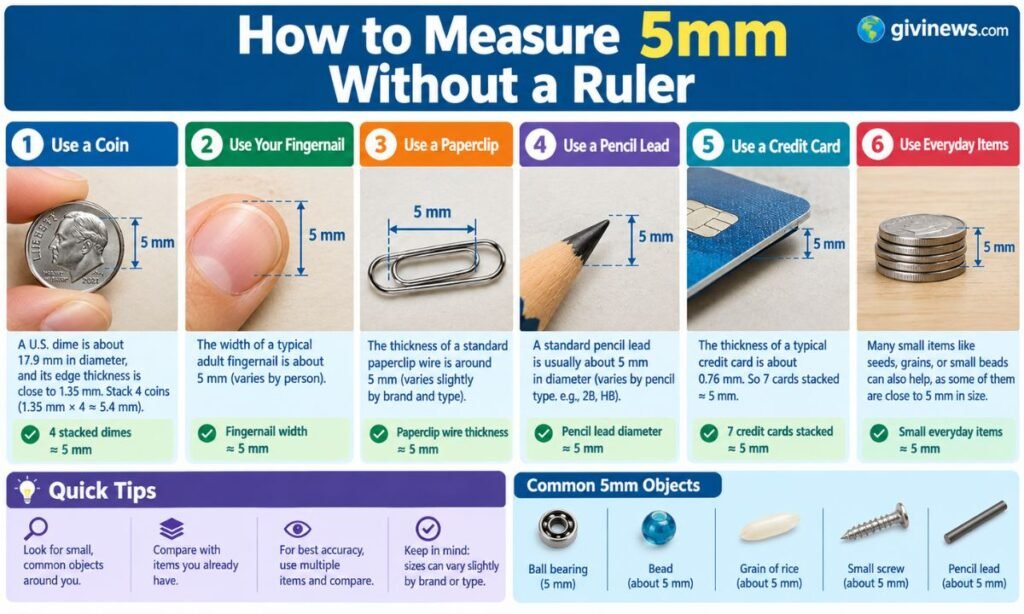
Method 1 — Pinky Fingernail Tip
Look at the width of your pinky nail and mentally cut it roughly in half. For many people, that’s close to 5 mm. It’s a quick estimate for casual use, not for precise work. Calibrate it once against a real ruler so you know your own number.
Method 2 — Use a 5mm Object
Keep a known 5 mm item nearby, such as an M5 bolt, a 5 mm drill bit or a 5 mm bead. Hold it next to what you’re measuring. It’s more reliable than any body-part trick, and it works for kids’ homework too.
Method 3 — Using a Ruler
This is the accurate way. Follow these steps:
- Line up the object’s edge with the zero mark. Don’t start from the ruler’s physical edge, since many rulers have a blank margin.
- Look straight down at the ruler to avoid parallax errors.
- Count five small lines, or find half a centimeter.
- For inches, use the mark just past 3/16.
Warning: don’t use an “on-screen ruler” for this. Screen scaling changes real sizes, so a line that looks like 5 mm can be 3 mm or 8 mm in reality.
5mm Quick Reference
| If you need… | Remember this |
| 5 mm in cm | 0.5 cm |
| 5 mm in inches | 0.197 in (just over 3/16 in) |
| 5 mm on a ruler | Five small lines |
| A household match | Black peppercorn |
| A hardware match | M5 bolt or 5 mm drill bit |
| An electronics match | 5 mm LED |
| Ten in a row | 5 cm |
| Twenty in a row | 10 cm |
Read More Measurement : How Big Is 5 mm
FAQs
How big is 5 mm in real life?
About the width of a black peppercorn or a pencil eraser’s thickness. It’s roughly 3/16 of an inch.
Is 5 mm the same as half a centimeter?
Yes. 10 mm equals 1 cm, so 5 mm is exactly 0.5 cm.
Is 5 mm bigger than a pencil eraser?
Slightly smaller. Standard erasers measure about 6 to 7 mm across.
What fraction of an inch is 5 mm?
It’s just over 3/16 of an inch (0.197 in versus 0.1875 in). The nearest finer fraction is 13/64 in.
How many 5 mm beads fit in 1 inch?
About five. One inch is 25.4 mm, and 25.4 ÷ 5 is just over five.
Summary
So, how big is 5 mm? It’s 0.5 cm, about 0.197 inches, or just over 3/16 of an inch. Picture a peppercorn, a standard 5 mm LED, an M5 bolt or a small pearl.
For quick estimates, use your pinky nail or a known 5 mm object. For anything important, use a real ruler and measure from the zero mark. Once you’ve seen the size a few times, it becomes easy to spot.









1 thought on “How Big Is 5 mm? Size Comparisons With Everyday Objects”