Three hundred feet is one of those numbers that sounds simple on paper but is genuinely hard to picture in real life. It’s too long to eyeball across a room, too short to compare to a mountain, and too “in-between” for most people to have a gut feeling about it. That’s exactly why so many people search for a real-world comparison instead of just a number on a converter.
In this guide, you’ll get a clear, visual answer to how long 300 feet actually is — using buildings, trees, whales, bridges, and everyday landmarks you can actually picture. By the end, you’ll never have to guess again.
Quick answers before we dive in:
- How long is 300 feet? It’s the length of a full football field playing surface (goal line to goal line), or almost exactly one American football field without the end zones.
- How many stories tall is 300 feet? Roughly 25 to 30 stories, depending on ceiling height.
- What is 300 feet visually? Picture the Statue of Liberty standing from base to torch, or three blue whales lined up nose to tail.
- What things are 300 feet tall? A 30-story building, a mature giant sequoia, a large Ferris wheel, or a modern wind turbine.
- How many football fields is 300 feet? Just under one full field (360 feet including end zones), or almost exactly the 100-yard playing field itself.
What Does 300 Feet Look Like? Objects Big and Long

Numbers on a page don’t mean much until you attach them to something familiar. Below are nine real-world objects and structures that are close to 300 feet in either length or height, so you can build your own mental yardstick.
| # | Object | Approx. Size | Type |
| 1 | Football field (playing area) | 300 ft long | Length |
| 2 | 30-story building | 300 ft tall | Height |
| 3 | Giant sequoia tree | 250–300 ft tall | Height |
| 4 | Large Ferris wheel | 200–300 ft tall | Height |
| 5 | Suspension bridge span section | 300+ ft | Length |
| 6 | Three blue whales in a row | ~300 ft | Length |
| 7 | Mega-yacht | 250–300+ ft | Length |
| 8 | Wind turbine tower | 260–300 ft | Height |
| 9 | Volcano lava tube | Varies, some 300+ ft | Length |
Read More Measurement ; how tall is 300 feet
1. A Football Field
The single most reliable comparison for 300 feet is the football field. The playing surface between the two goal lines measures exactly 300 feet (100 yards). If you add both 10-yard end zones, the full field grows to 360 feet, so it’s worth remembering that “one football field” technically refers to two slightly different numbers depending on whether the end zones are included.
Next time you’re at a game, look from one goal line to the other. That entire stretch of grass is your 300-foot reference point.
2. The Height of a 30-Story Building

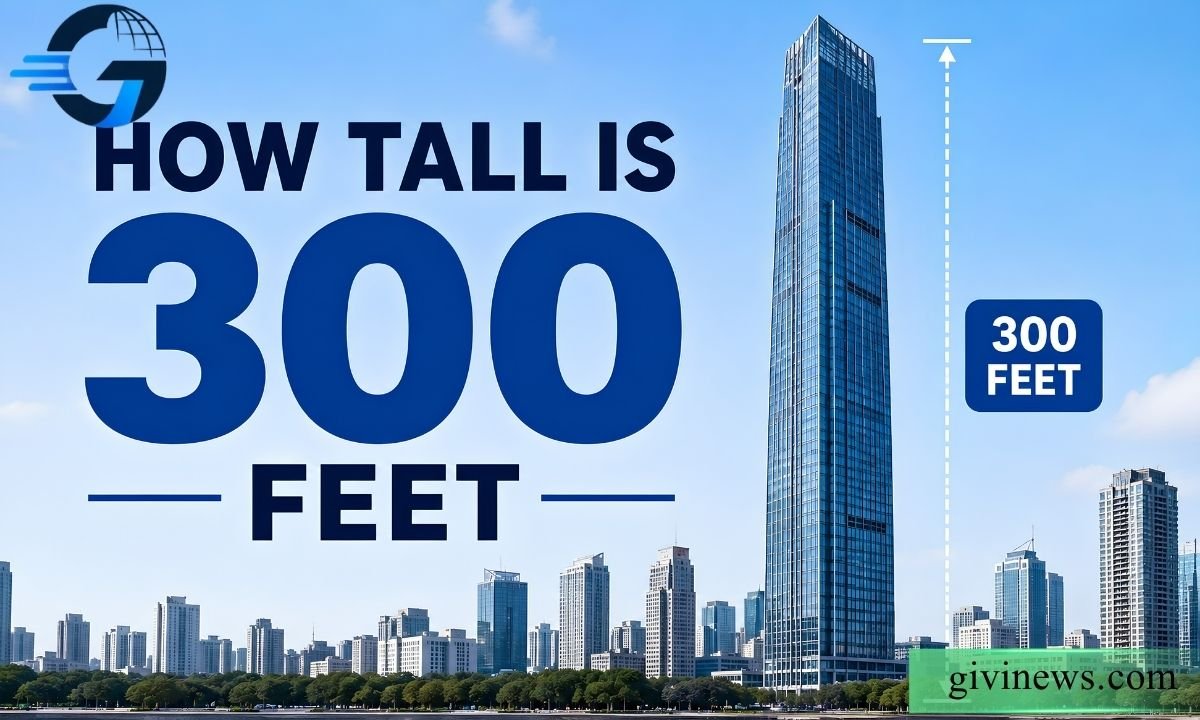
Vertically, 300 feet lines up closely with a 30-story office or residential tower. Most commercial floors run about 10 feet high once you account for the ceiling, flooring, and the mechanical space in between. Stack 30 of those floors and you land almost exactly at 300 feet.
This height also happens to matter in the real world beyond curiosity — building codes and fire-safety regulations often treat structures near this mark differently, since ladder trucks and emergency access become more complex once a building crosses this threshold.
3. Giant Sequoia Trees
Nature builds its own skyscrapers. Giant sequoias, found mostly in California, regularly grow between 250 and 300 feet tall, with some of the largest specimens pushing right up against the 300-foot mark. Unlike a building, a sequoia gets there with nothing but sunlight, water, and a few thousand years of patience.
Standing at the base of one of these trees and looking straight up gives a far more visceral sense of 300 feet than any number ever could.
4. Large Ferris Wheels
Modern observation wheels have grown dramatically since the original Ferris Wheel debuted in Chicago in 1893. Many contemporary giant wheels found in major cities stand in the 200 to 300-foot range, offering panoramic views that rival short skyscrapers. A wheel near the top of that range gives riders a bird’s-eye look at a skyline from roughly the same height as a 30-story building.
5. Suspension Bridge Span Sections
Suspension bridges are engineered in massive segments, and individual span sections — the distance between support towers or anchor points — frequently exceed 300 feet, especially on smaller and mid-sized crossings. While record-breaking bridges span thousands of feet in total, a single 300-foot section gives you a sense of just how much steel and cable is required to hold up one relatively “short” stretch of roadway.
6. Blue Whales in a Line (3 Whales = 300 Feet)
Blue whales are the largest animals ever known to have lived on Earth, typically measuring 90 to 100 feet from nose to tail. Line up three of them head to tail and you’ve covered roughly 300 feet. It’s a strange way to measure distance, but it’s an effective one — few images capture sheer scale like three of the planet’s biggest creatures parked bumper to bumper.
7. Mega-Yachts
At the top end of private yacht construction, mega-yachts regularly stretch beyond 250 feet, with some of the largest in the world crossing the 300-foot mark. These vessels function almost like floating buildings, complete with multiple decks, helipads, and swimming pools, all packed into a hull roughly the length of a football field.
8. Wind Turbine Towers
Modern utility-scale wind turbines are far taller than most people expect. The tower alone — not counting the blades — often reaches 260 to 300 feet, putting it in the same height class as a mid-rise skyscraper. Once you factor in the blade sweep, the total tip height of many turbines climbs even higher, but the tower height by itself is a solid real-world stand-in for 300 feet.
9. Volcano Lava Tubes
Lava tubes form when the outer surface of a lava flow cools and hardens while molten rock continues moving underneath, eventually draining out and leaving a hollow tunnel behind. Some of the world’s longest and largest lava tubes stretch well past 300 feet, with certain chambers and passageways reaching lengths that rival a football field, buried entirely underground.
How Long Is 300 Feet to Walk?
At an average walking pace of about 3 to 3.5 feet per second, covering 300 feet on foot takes roughly 20 to 30 seconds for most adults. That’s about the time it takes to walk from one end of a football field’s playing surface to the other, or to cross a moderately sized parking lot.
For context:
- A relaxed stroll: about 30 seconds
- A brisk walk: closer to 20 seconds
- A light jog: under 15 seconds
How Tall Is 300 Feet Compared to a Human?
The average adult stands around 5.5 to 6 feet tall, meaning 300 feet is roughly 50 people standing on each other’s shoulders. It’s also close to 60 times the height of a typical one-story doorway.
How Tall Is 300 Feet in Stories?
Using a standard commercial floor height of about 10 feet, 300 feet works out to approximately 30 stories. In buildings with taller ceilings, such as older architecture or luxury residential towers, that number can drop closer to 25 stories.
How Tall Is 300 Feet Height-Wise, Overall?
In plain terms, 300 feet sits comfortably between a large mid-rise building and a small skyscraper. It’s tall enough to dominate a suburban skyline but modest compared to true supertall towers, which often exceed 1,000 feet.
300 Feet Tall Building — What Does That Actually Mean?
A 300-foot building typically falls into the “mid-rise to high-rise” category depending on the city. In dense urban centers surrounded by supertalls, it can look almost ordinary. In a smaller town, that same structure would likely be the tallest building for miles.
Understanding the Foot
The foot is one of the oldest units of measurement still in everyday use, historically based on the length of a human foot before being standardized. Today, one foot is defined as exactly 12 inches, and 3 feet make up one yard. Three hundred feet, then, is the same as 100 yards — which is exactly why the football field comparison works so cleanly.
Feet remain the standard unit for measuring building heights, road distances, and altitude in the United States, even though most of the world has shifted to the metric system for these same purposes.
Metric vs. Imperial Systems

If you’re more comfortable thinking in metric terms, here’s how 300 feet translates:
| Unit | Equivalent |
| Feet | 300 ft |
| Yards | 100 yd |
| Inches | 3,600 in |
| Meters | ≈ 91.44 m |
| Kilometers | ≈ 0.091 km |
| Miles | ≈ 0.057 mi |
The imperial system (feet, yards, miles) is still standard in the United States for everyday measurements, while most other countries rely on the metric system (meters, kilometers). Knowing both conversions is useful whether you’re reading an American building spec sheet or an international engineering document.
Read More Measurement ; how tall is 300 feet
FAQs
How tall is 300 feet in stories?
About 30 stories, based on an average floor height of 10 feet per level.
How tall is 300 feet compared to a person?
It’s roughly 50 times the height of an average adult, who stands around 5.5 to 6 feet tall.
What building is about 300 feet tall?
A typical 30-story office or residential tower is close to 300 feet tall.
Is the Statue of Liberty 300 feet tall?
Yes, the Statue of Liberty stands about 305 feet from the ground to the tip of the torch.
How many football fields is 300 feet tall?
None going up — 300 feet is a horizontal comparison, equal to the length of one football field laid flat.
Conclusion
Three hundred feet might start as an abstract number, but once you connect it to real objects — a football field, a 30-story building, a giant sequoia, or three blue whales lined up end to end — it becomes something you can actually picture and remember. Whether you’re estimating a building’s height, planning a walk, or just satisfying your curiosity, these comparisons turn a plain measurement into a mental image that sticks.
Next time someone asks how big 300 feet really is, you won’t need a calculator — you’ll have a whale, a tree, or a stadium field ready to go.